ZNetLab › Published › Question
EtherChannel will not bundle — ports stay independent
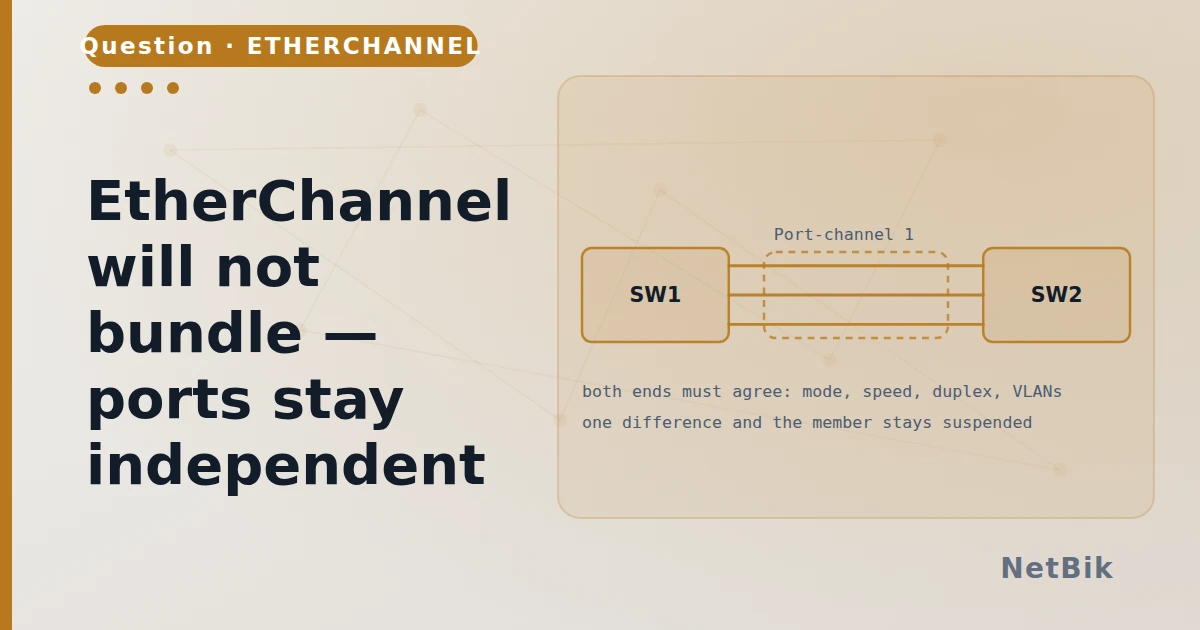
Three links between two switches, configured as an LACP channel on both sides. The port-channel interface exists but never comes up:
SW1# show etherchannel summary
Group  Port-channel  Protocol    Ports
------+-------------+-----------+----------------------------
1      Po1(SD)       LACP        Gi0/1(I) Gi0/2(I) Gi0/3(D)
Two ports are (I) and one is (D).
1 answer
@admin · 2026-10-09
The flags are the answer. (I) means independent — the port is up but is not in the bundle — and (D) means down.
For a port to join, every one of these must match on both ends and across all member ports:
- speed and duplex
- switchport mode (all access, or all trunk)
- the allowed VLAN list and the native VLAN, if they are trunks
- the access VLAN, if they are access ports
- spanning-tree cost and port priority
Check them side by side rather than one at a time:
SW1# show interfaces Gi0/1 switchport | include Mode|Native|Trunking VLANs
SW1# show interfaces Gi0/2 switchport | include Mode|Native|Trunking VLANs
A single mismatched allowed-VLAN list on one member is enough to leave it (I) while the others bundle.
The (D) port is a separate problem — that one is physically down or
administratively shut, so start with show interfaces Gi0/3 and work up from
layer one.
One more thing worth checking: LACP mode. active/active and
active/passive both work; passive/passive never does, because neither
end starts the negotiation. And if one side is running PAgP (desirable) and
the other LACP (active), they will never form — the protocols do not
interoperate.
Can you answer this?
Replies, likes and bookmarks live in the community half, which needs a free account. Writing here is free too, and everything is reviewed before it is published.
Open this in the communityEverything publishedHow this works